Blog · 4 min read
Which AI video model should you use? A practical guide
There are dozens of AI video models, and each has limits that a spec sheet buries. Start from the job instead. Is it one clip or a whole story? Does anyone speak? Which shape, how long, and how much do you want to spend?
Start from the job, not the model
"Which model is best?" has no single answer, because the models are good at different things. Five questions narrow the field quickly:
- One clip, or several shots with the same people?
- Does anyone speak?
- How long is each shot?
- What shape and size?
- What's the budget?
Answer those, and usually only a handful of models fit.
One clip, or a story with the same people?
This is the biggest split. A single clip can come from any model. A story needs every shot to keep the same faces, clothes and places, and that depends on whether the model takes reference pictures of your cast and locations in every shot.
| Keeps the cast across shots | How |
|---|---|
| Seedance 2.5 and 2.0 (with Fast and Mini) | Reference pictures in every shot |
| MiniMax H3 | Reference pictures in every shot |
| Gemini Omni | Up to 10 reference pictures and 3 reference videos |
| Vidu Q4 Reference | Up to 12 reference pictures and 3 voice clips |
| Wan 3.0 | Reference pictures in every shot |
| Kling 4.0 | No reference pictures. Each shot starts from a frame instead: an opening still made from the cast and place photos, then the last frame of the shot before. |
Models such as Google Veo 3.1, xAI's Grok and LTX start from one picture or from text. They are excellent for single clips, a product shot or a scene from one photo, but harder to keep consistent across a story.
One thing to know about Seedance: it only accepts faces it can verify. A photo of a real person has to be registered, with that person's consent, before Seedance will use it. Characters created in Studio are drawn in a way Seedance accepts. The other models use the face you give them.
Does anyone speak?
Most current models make sound with the picture: Seedance, MiniMax H3, Kling 4.0, Veo 3.1, Gemini Omni and Wan 3.0, and Vidu Q4 as an option. How well they speak depends on the language. For a film, a fixed voice per character keeps everyone sounding the same in every shot; see AI video in Hindi, Tamil, Telugu and other languages for what we found.
How the characters act matters as much as how they sound. Every model plays an over-written direction big; see Why AI actors overact.
How long is each shot?
The longest single clip each model makes:
| Model | Longest clip |
|---|---|
| Seedance 2.5 | 30 s |
| Kling 4.0 | 30 s |
| Wan 3.0 | 30 s |
| LTX 2.5 Fast | 20 s |
| Vidu Q4 Reference | 16 s |
| Seedance 2.0, 2.0 Fast, 2.0 Mini | 15 s |
| MiniMax H3 | 15 s |
| Gemini Omni | 15 s |
| Grok | 10 s |
| Veo 3.1 | 8 s |
Anything longer is several shots joined together. Movie splits a story into shots and stitches them for you; Director lets you arrange clips by hand.
What shape and size?
Most models make 16:9, 9:16 and 1:1, and some add cinema 21:9. Resolutions vary: Kling 4.0 makes 720p and 1080p, MiniMax H3 768p or 2K, Vidu Q4 540p up to 4K, and Gemini Omni 360p up to 4K.
A practical habit: make drafts at a low resolution, then make the final at the size you need. In Movie, 480p is the default for exactly this reason.
What will it cost?
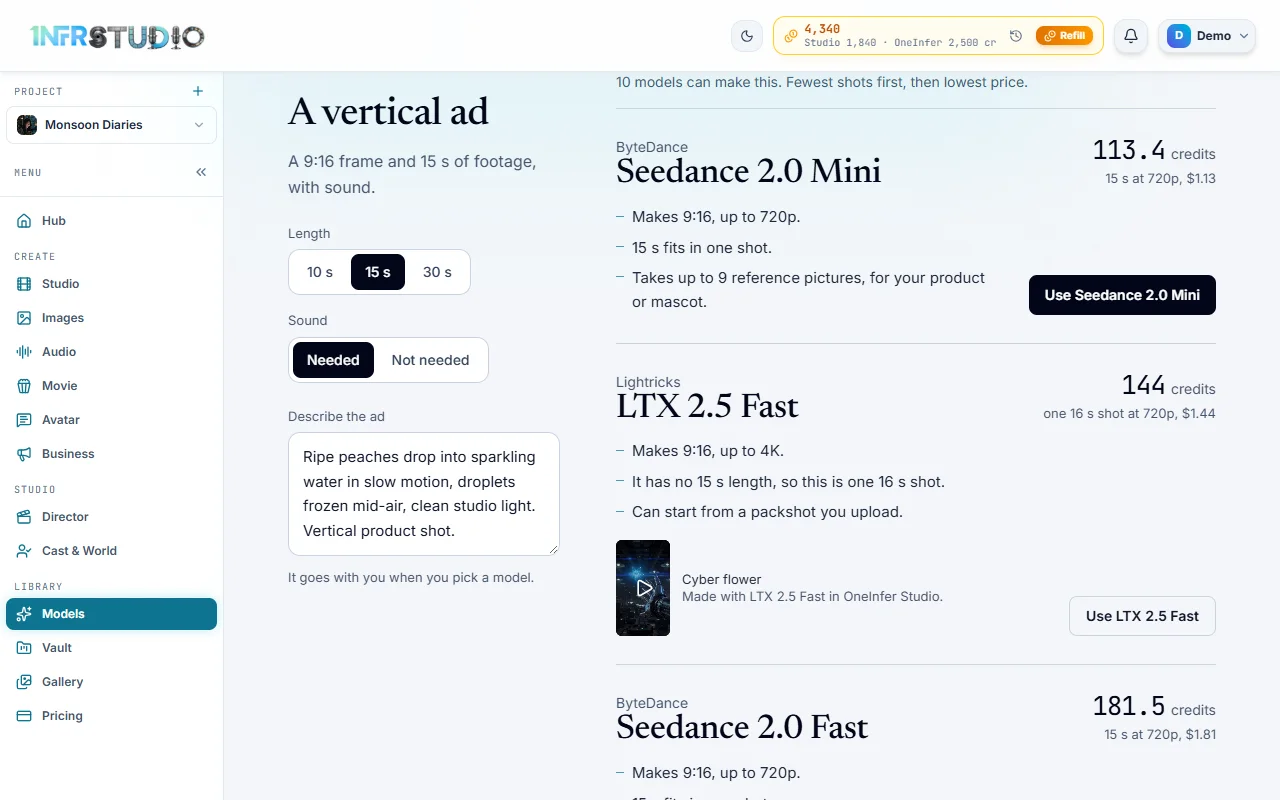
Video is priced per second, and the spread between models is wide. Approximate prices at 720p with sound, as of mid-November 2026 (100 credits = $1):
| Model | Credits per second, about |
|---|---|
| Seedance 2.0 Mini | 7.6 |
| MiniMax H3 (768p) | 8 |
| Wan 3.0 | 8.5 to 11 |
| Vidu Q4 Reference | 9.5 |
| Seedance 2.0 Fast | 12 |
| Kling 4.0 | 15.7 |
| Seedance 2.5 | 23 |
So a one-minute film costs roughly 460 credits ($4.60) on the cheapest of these and about 1,380 ($13.80) on the most expensive, before voices, music and any shots you remake. Prices change, so check the live price: the Models page prices each model for your exact job, and the Generate button always shows the final number.
Two ways to spend less:
- Draft cheap, finish well. Try the story on a lighter model at low resolution, then make the final on the model you prefer.
- Wait a little. For some models, Movie offers Within 12 hours · cheaper, which makes the film on OneInfer's own GPUs at a lower per-second price.
Quick picks
- A story with the same cast, on a budget: Seedance 2.0 Mini or MiniMax H3.
- A longer film where consistency matters most: Seedance 2.5.
- Many reference pictures at once (product, people and place): Vidu Q4 Reference or Gemini Omni.
- One striking clip from a photo or a sentence: Veo 3.1, Kling 4.0 or Wan 3.0.
- Long single takes: Seedance 2.5, Kling 4.0 or Wan 3.0, up to 30 seconds.
These are starting points, not verdicts. The quality gap between the leading models is smaller than their prices suggest, so make one short test shot with your own cast and compare.
Questions
Which AI video model is best?
It depends on the job. For a story with the same characters, pick a model that takes reference pictures in every shot, such as Seedance or MiniMax H3. For a single striking clip, Veo 3.1, Kling 4.0 or Wan 3.0. Then compare price and length.
Which AI video model keeps the same face across shots?
Models that take reference pictures in every shot: Seedance 2.5 and 2.0, MiniMax H3, Gemini Omni, Vidu Q4 Reference and Wan 3.0. Kling 4.0 keeps faces by starting each shot from a frame.
How long can an AI video clip be?
Up to 30 seconds in one clip with Seedance 2.5, Kling 4.0 or Wan 3.0; 15 seconds or less with many others. Longer videos are made of several shots joined together.
How much does AI video cost per minute?
At 720p with sound, roughly $4.60 to $13.80 a minute with the models in this guide, as of November 2026. Check the live price before you make anything.
In the docs: Models · Studio · Movie and Film · Credits and plans